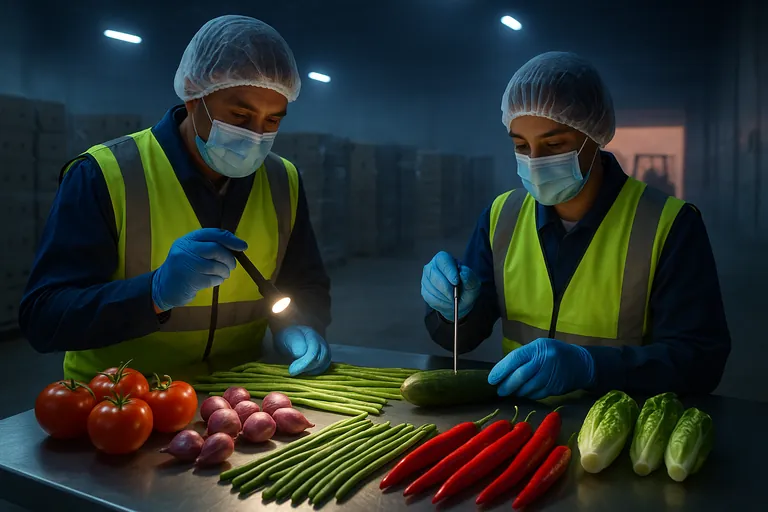
A practical, 2026-ready playbook for writing, measuring, and enforcing Indonesian IQF cut size specifications. Includes common cut sizes, realistic tolerances, simple caliper/sieve methods, and AQL sampling so you can issue a clear RFQ and verify at receiving.
If you’ve ever opened a container and found carrot dice too small, green beans too long, or broccoli heads that won’t cook evenly, you’re not alone. Size mismatch is the most common reason IQF vegetables get flagged at receiving. The good news is you can prevent 90% of it with a precise, testable cut-size spec that Indonesian processors can run against. Here’s the 2026-ready playbook we use.
The three pillars of a bulletproof IQF cut size spec
-
Define the cut clearly. Use a target size, a measurement method, and an acceptance threshold. Avoid “about” or “ approximately.”
-
Make it measurable at your dock. If your quality team can’t verify the spec with a caliper or sieve in 10 minutes while product is still frozen, it’s not a good spec.
-
Link it to AQL. Decide how many out-of-spec pieces you’ll accept before the lot fails. Put the AQL 2.5 sampling plan into your PO.
Taken together, these three remove ambiguity and stop back-and-forth on “interpretations.”
Common Indonesian IQF cut sizes buyers actually use
What are typical carrot, green bean, and broccoli sizes?
Carrot (IQF, from fresh export-grade roots like our Carrots (Fresh Export Grade))
- Dice: 6×6 mm, 10×10 mm, 12×12 mm. Rounds: 5–10 mm thickness. Julienne: 5×5×30–40 mm.
- For mixed veg, 10×10 remains the global default. 12×12 is trending in 2025–2026 for better forkability in ready meals.
Green beans
- Cut length: 20–30 mm or 25–35 mm. Whole beans for premium lines are 80–120 mm, but cut lengths are far more common for blends.
Broccoli florets
- Floret grading is by largest dimension: 20–40 mm is the standard retail grade. 30–50 mm works for foodservice and roasting kits. Stalk length usually limited to 30–40% of total length.
Related items we often size-match into blends
- Bell pepper strips/dice: strips 6–8 mm wide, 30–50 mm long. Dice 10×10 or 12×12. See Frozen Paprika (Bell Peppers) - Red, Yellow, Green & Mixed.
- Okra: sliced 10–20 mm. Whole pods 50–80 mm. See Premium Frozen Okra.
- Sweet corn: kernels as-is (cut size not applicable). See Premium Frozen Sweet Corn.
- Mixed veg baseline: carrot 10×10, green beans 20–30, peas, corn. That’s our standard for Frozen Mixed Vegetables.
Practical takeaway: Start from these ranges. You’ll get quicker confirmations from Indonesian plants because tooling and blanch curves are already set up for them.
How to set realistic size tolerance and acceptance criteria
Here’s a spec template we’ve used across multiple buyers that balances precision with plant reality.
Carrot dice 10×10 mm (example applies similarly to 6×6 and 12×12)
- Definition: Square dice, target 10 mm, measured with square-hole sieve plates and calipers while frozen.
- Tolerance and uniformity: At least 85% of pieces must be between 8–12 mm on the smallest cross-section. Max 10% between 12–14 mm or 6–8 mm combined. Fines/slivers (<6 mm on any side) max 3% by count.
- Defects related to size: Broken mash and slivers count as out-of-spec for size.
Green bean cut length 20–30 mm
- Definition: Straight cut, measured tip-to-cut end while frozen.
- Tolerance and uniformity: At least 85% between 20–30 mm. Up to 10% between 15–20 mm or 30–35 mm combined. Outliers <15 mm or >35 mm max 5%. Broken pieces max 10%.
Broccoli florets 20–40 mm
- Definition: Measure the largest dimension of the floret crown to stalk end. Stalk length not more than 40% of total floret length.
- Tolerance and uniformity: At least 80% between 20–40 mm. Up to 10% 10–20 mm. Up to 10% 40–50 mm. Clusters that don’t separate with a light tap count as oversize. Excess stalk ratio >40% counts out-of-spec.
Why these numbers? They match Indonesian cutting and grading equipment capability and keep foodservice cook times consistent. If you push for 95% in-range on hand-cut florets, you’ll pay more and still risk line slowdowns.
Measuring size on frozen product at receiving
What’s the simplest, consistent method: caliper or sieve?
Both, applied by product type.
-
Dice and small strips: Use square-hole sieve plates (for example, 8 mm, 10 mm, 12 mm) and a stainless caliper. Tare a tray. Sieve 200–300 g quickly so product stays frozen. Weigh or count what passes and what’s retained. Spot-check 20–30 pieces with calipers for confirmation.
-
Linear cuts (green beans, okra slices, pepper strips): Use a stainless ruler or caliper. Randomly select 50 pieces per bag from five bags. Measure length or width while still frozen.
-
Florets: Measure the largest dimension with calipers. Record stalk ratio visually against a printed template. Count any fused clusters as oversize unless they separate with a light tap.
-
Photo board: Lay pieces on a white board with a printed mm scale, lot number, date, and bag number. Take one overhead photo per sample set. It prevents 80% of later disputes.
Need a ready-to-use photo board and a one-page “caliper vs sieve” SOP your team can print? Contact us and we’ll share the templates. If you want us to adapt them to your SKU list and AQL plan, just Contact us on whatsapp.
AQL 2.5 sampling that works for size
How many out-of-spec pieces are acceptable before I reject a lot?
Use ANSI/ASQ Z1.4, AQL 2.5, attribute sampling. Treat any piece outside your specified tolerance as a size defect.
-
Choose sample size based on lot size. For many frozen veg receipts, you’ll land on one of these code letters:
- Code L (n = 200 pieces): Accept 10 defects, reject 11.
- Code M (n = 315 pieces): Accept 14, reject 15.
- Code N (n = 500 pieces): Accept 21, reject 22.
-
Practical approach we use: Pull 5 inner bags. From each bag select 50–100 pieces depending on item size. That gives you 250–500 pieces total. It lines up with Code M or N and keeps inspection under 15 minutes.
-
Pre-shipment inspection: Ask your supplier to run the same AQL plan and send the worksheet and photo boards. It should mirror your receiving test to close the loop.
Will moving from 10×10 to 12×12 carrot dice change cost and cook time?
Yes. Here’s how.
-
Cook time: 12×12 typically needs 15–25% longer blanch or cook than 10×10 for the same bite, because the surface-area-to-volume ratio drops. If you par-cook, adjust time or temperature accordingly.
-
Yield and sensory: Larger dice hold structure better in retort and reheats. They bleed less color and lose fewer small slivers in kettles. If you’re seeing over-soft carrots in a 4-way mix, bumping to 12×12 often fixes it without changing suppliers.
-
Cost: In Indonesia, there’s usually no surcharge for switching from 10×10 to 12×12 on the same raw material, but you may see a slight line-speed gain and lower trim loss on the processor side. We’ve seen net costs stay flat or drop 1–2% depending on grade and season.
-
Piece count per kg (sanity check): A 10×10×10 mm piece weighs roughly 0.9–1.0 g. Expect around 950–1,100 pieces per kg. A 12×12×12 mm piece runs 1.6–1.8 g, so roughly 550–650 pieces per kg. That can influence pack fill and portion visuals.
What to request from suppliers before issuing a PO
What should I ask to confirm cut size up front?
- A signed cut-size specification with target, tolerance, and acceptance criteria written exactly as above.
- A measurement SOP stating caliper model or sieve aperture sizes and the AQL 2.5 plan they’ll use.
- Pre-shipment photo boards on a printed mm grid for each item and batch.
- A 2 kg “golden sample” retained at the plant and a 2 kg retain sent to you. Label both with lot and cut date.
- For blends, a compatibility note. Example: “Carrot 10×10, beans 20–30, peas, corn. All items target 12–16 minutes boil-to-fork tender.” See our standard Frozen Mixed Vegetables for a proven baseline.
If you’re customizing peppers or okra to fit a new meal kit, ask for a 1–2 hour pilot on your exact size. Our teams can run 6–8 mm pepper strips or 10–12 mm okra slices to match your cook curve. Refer to Frozen Paprika (Bell Peppers) - Red, Yellow, Green & Mixed and Premium Frozen Okra for workable ranges.
Can one cut size spec work across a 4‑way mix?
Can I avoid segregation and still hit uniform cook?
Yes, if you choose compatible sizes. Here’s a rule of thumb we’ve learned the hard way.
- Keep smallest cross-section similar. Carrot 10×10 pairs well with beans 20–30 mm, peas, and corn. Carrot 12×12 prefers beans 25–35 mm to avoid chewy beans and mushy carrots.
- Avoid mixing long strips with peas in high-velocity kettles. Strips tangle and shelter peas, leading to uneven heat transfer. If you need strips, raise pea proportion or cut strip length to <35 mm.
- In 2025–2026 we’ve seen more buyers move to 12×12 carrots and 25–35 mm beans in ready meals to improve bite after microwave reheat. That trend is strong in the EU and gaining in APAC.
If you’re unsure, send us your cooking protocol and finished product targets. We’ll propose a size matrix from our Indonesian lines that hits both cook and visual targets. Or browse what’s already dialed-in here: View our products.
Final takeaways you can use today
- Write the spec so it can be audited frozen with a caliper or sieve in under 10 minutes. Include AQL 2.5 and acceptance numbers in the PO.
- Use proven Indonesian size bands: carrot 10×10 or 12×12, beans 20–30 or 25–35 mm, broccoli 20–40 mm. Tune tolerances to 80–85% in-range, with clear limits for slivers, oversize, and broken pieces.
- Close the loop with photo boards and a golden sample on every lot. It prevents most disputes and shortens investigations from days to hours.
We’ve found this system eliminates surprises and makes both procurement and production run smoother. If you want the one-page “how to write IQF vegetable cut size specification” template plus our RFQ photo board, just Contact us on whatsapp.