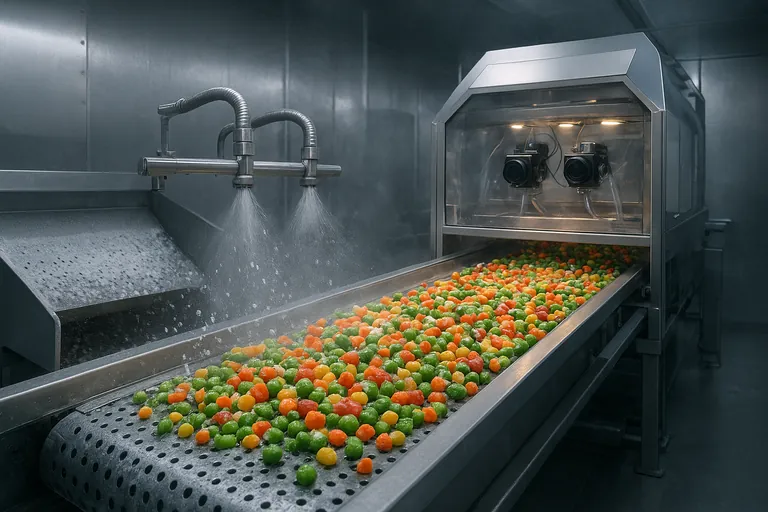
A field-tested playbook for Indonesian plants to reduce IQF optical sorter false rejects below 3% by controlling surface frost, condensation, and singulation—without sacrificing throughput.
We cut false rejects from 8–12% down to 2.4–3.0% on IQF green beans, carrots, and peppers in humid East Java. We didn’t slow the line. We controlled surface frost, kept lenses clear, and tuned sorter recipes with ruthless validation. Here’s the exact system our Indonesia‑Vegetables team uses in tropical plants.
The 3 pillars of low false rejects in a tropical IQF room
-
Environment and optics control. Condensation and fog are the silent killers. In our climate, lenses fog in 20–40 minutes if you don’t protect them. We stabilize the sorter’s microclimate with dry air purge and gentle lens heating. Cross‑polarized lighting helps “see through” glaze.
-
Product presentation. Sorters make smart decisions only when they can “see.” That means one clean, dry layer on the belt. We remove surface frost with dewatering and air knives, and we dial singulation so overlap stays low even at 4–6 t/h.
-
Recipe tuning and validation. Sensitivity, brightness, and minimum defect size drive false rejects more than people expect. We tune after every freezer defrost and verify with tray checks so we don’t drift into 5–7% over weeks.
This approach is line‑agnostic. We’ve applied it on IQF Frozen Mixed Vegetables, Frozen Paprika (Bell Peppers), Premium Frozen Okra, Premium Frozen Sweet Corn, and Premium Frozen Potatoes.
Weeks 1–2: Audit and quick wins that move the needle
- Map dew point and RH along the last 10 meters before the sorter. In Indonesian monsoon months we often read 70–85% RH near the infeed. Your target at the sorter hood is low dew point, not just low temperature. We aim for dry‑air purge at ≤ −20°C dew point inside optical housings and ≤ 30–40% RH in the sorter enclosure.
- Get the surface dry, fast. Add a short dewatering shaker plus one blower‑driven air knife bank before the inspection area. Don’t use compressed air for de‑icing unless it’s a small spot fix. Blowers give steadier velocity and lower cost.
- Lock in an inspection cadence. Night shift is where false rejects creep up. We set a timer: lens inspect and light wipe every 2 hours, plus an extra check 30 minutes after any freezer defrost or belt wash.
- Baseline your numbers. Measure belt occupancy (target 65–75%), overlap rate (aim under 8–10%), and current false reject rate by SKU. On green beans we usually see 5–9% pre‑work. You’ll use these as your north star.
Immediate wins usually take false rejects down 1–3 points without touching sorter sensitivity.
Weeks 3–6: Engineering the presentation and optics
-
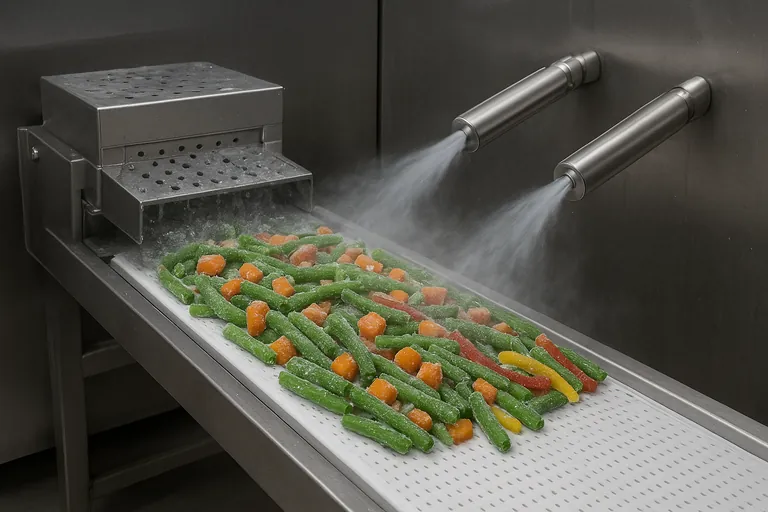
Dewatering and air knives. For mixed veg and peppers, a 600–900 mm shaker with moderate throw and 16–22 Hz frequency knocks off snow. Follow with 2 air knife passes at 25–35 m/s, 30–45° angle, 150–250 mm above the bed. Keep the knife-to-belt perpendicular to avoid rolling okra pods or edamame off spec. For delicate cuts, back off to 20–25 m/s and add a third gentler pass.
-
Belt speed and singulation. Most TOMRA/Key recipes tolerate 2.5–4.0 m/s, but if overlap exceeds 10% you pay in false rejects. We reduce infeed rate first, not speed, until we hit a single layer with visible belt between pieces. On green beans, use an alignment vibratory feeder; on diced carrots, a feed spreader to even the bed depth.
-
Optics and lighting. Add cross‑polarizing films on lights and lenses to cut glaze glare. Maintain lens temperature 10–15°C above local dew point. That usually means lens heaters set so glass stays 20–25°C in a 5–10°C enclosure. Purge cameras with 5–15 L/min of dry air at ≤ −20°C dew point.
-
Rejector tuning. Too long a burst causes “collateral damage.” Typical starting points we’ve validated: 8–12 ms valve open for small dice or corn, 12–18 ms for okra rings and pepper strips, with the minimum object size filter active so the system doesn’t fire on a specular frost sparkle.
If you want a second set of eyes on your setup or a quick remote review of belt videos, reach out and we’ll share a checklist tailored to your SKU mix. Need help with your specific situation? Contact us on whatsapp.
Weeks 7–12: Lock recipes by SKU and scale the gains
- Build per‑SKU recipes. Okra and edamame handle air differently than peppers or carrots. Save profiles with belt speed, light intensity, polarization, sensitivity, min defect size, and ejector timing. Name them clearly, e.g., “Paprika Strips 12mm G3 3.2mps v5.”
- Validate weekly, not just after maintenance. Do 10 trays of 500 g across belt width. Hand‑pick to estimate over‑reject vs misses. Log the three levers you last changed and their effect.
- Upgrade only when look‑alikes win. If you’re fighting color look‑alikes or stems in Frozen Paprika, hyperspectral or enhanced NIR can separate chemistry rather than color. We see ROI when yield loss from false rejects stays >2% after environmental fixes. On a 4 t/h line, 16 h/day, 300 days, each 1% yield recovered at $800/t is ~$153,600/year.
Answers to the questions we’re asked most
Why does surface frost cause high false rejects on IQF optical sorters?
Frost and glaze create bright specular highlights and change NIR reflectance, so the sorter “sees” a false defect. Overlapping frosty pieces look like one large foreign object. Remove the frost and the algorithm calms down.
What product and core temperatures minimize condensation before the sorter in a tropical plant?
In our climate, you won’t beat dew point with temperature alone. Keep core product at −12 to −18°C for integrity, but control the air around the sorter. Use a local enclosure at 5–10°C with very dry air and air curtains to isolate from humid corridors. The key is dry air, not extra chilling of the product.
How should I set air knives and dewatering to remove glaze without damaging vegetables?
- Start with blower knives at 25–35 m/s, 30–45° angle, 150–250 mm above product.
- For tender items like Premium Frozen Okra or pepper strips, reduce to 20–25 m/s and add a third pass rather than cranking pressure.
- Use a short dewatering shaker ahead of knives so you’re blowing water off produce, not just redistributing it.
Do I need camera lens heaters or a dry air purge in Indonesia to stop fogging?
Yes. In our experience, purge alone won’t hold up during monsoon humidity spikes. Combine a gentle lens heater to keep glass above local dew point with a dry‑air purge at ≤ −20°C dew point into the optical box. Add cross‑polarization to cut glare from residual glaze.
What is a good false reject rate target for IQF vegetables like green beans and carrots?
- Green beans whole cuts: 1.5–2.5% at 4–6 t/h once stabilized.
- Carrot dice: 2–3%.
- Pepper strips: 2–4% depending on color variation and stem load.
- Corn kernels: 1–2% if singulation is strong. If your incoming defect load is unusually high, expect a temporary bump until upstream trimming or sieving is fixed.
Which sorter settings most affect false rejects: sensitivity, brightness, or minimum defect size?
All three. We usually see the biggest gains from:
- Minimum defect size. Raising it by 1–2 mm often cuts “glare hits” with negligible risk.
- Brightness/exposure. Over‑bright images exaggerate frost glare. Re‑balance after any lighting or lens cleaning.
- Sensitivity/contrast. On TOMRA/Key‑style UIs, this is the temptation dial. Move in small steps and validate, because it also drives misses. Don’t ignore ejector valve duration. Over‑long bursts push good product out with the bad.
How often should we clean and inspect lenses during the night shift in high humidity?
Every 2 hours routinely, plus a targeted check 30 minutes after any freezer defrost, belt wash, or when operators notice rising rejects. Use lint‑free wipes and isopropyl alcohol. Re‑calibrate brightness/white balance after cleaning.
Five mistakes that keep false rejects high
- Blasting frost with compressed air. You create micro‑ice that re‑freezes downstream. Use blower knives and dewatering instead.
- Chasing sensitivity while overlap is high. Fix presentation first. Overlap above 10% will beat any recipe.
- Ignoring dew point. A 6°C room at 70% RH still fogs lenses. Dry the air around optics.
- One recipe for all SKUs. Frozen Mixed Vegetables and Premium Frozen Sweet Corn need different minimum object sizes and ejector timing.
- Skipping validation after maintenance. Post‑defrost, your “good” recipe can turn into a reject machine. Always re‑validate.
Resources and next steps
If you take nothing else: control surface frost, keep lenses warm and dry, and validate weekly. That alone gets most Indonesian plants under 3% false rejects without sacrificing throughput. When you’re ready to standardize recipes across SKUs like Frozen Paprika or Premium Frozen Potatoes, we’re happy to compare notes from our lines and partner plants. Questions about your project? Call us or explore what we process and ship: View our products.
We’ve found that the plants who win treat sorter performance like any other critical CCP: measured, trended, and tuned with intent. Do that in Indonesia’s humidity, and you’ll stay under 3% while your competitors chase ghosts in the algorithms.