A practical, spec-first playbook for switching from PET/PE to recyclable mono-PE bags for IQF vegetables in 2026—film structures, thickness, seal strength, zippers, print, line settings, and a copy‑paste RFQ template for Indonesian suppliers.
Why 2026 is the year to move to mono-PE for IQF vegetables
We’ve helped multiple buyers switch from PET/PE to mono-PE on real, export-grade frozen lines in Indonesia. In our experience, you can hit the same drop-test performance and retail look while unlocking lower EPR fees in the EU and simpler recyclability claims. And you don’t need a new line to do it. You just need the right film spec, zipper, and sealing window.
Here’s the thing. Frozen vegetables don’t “breathe,” so oxygen barrier is usually over-specified. Stiffness and cold-crack resistance matter more. Get those right and the transition gets boring—in the best way. Let’s walk through exactly what works on Indonesian IQF lines in 2026.
The 3 pillars of a successful mono-PE switch
- Structure and thickness. Choose MDO-PE for outside stiffness and mLLDPE/EVA for the sealant. Add EVOH only when you truly need aroma or oxygen barrier.
- Sealing and cold performance. Target a forgiving seal window with metallocene LLDPE, tune jaw temperature and dwell, and validate drop tests at -18 to -23°C.
- Print and conversion. Use PE-compatible inks and solventless adhesives when laminating PE/PE, or go single-web with high-corona MDO-PE for speed.
Takeaway: Design around stiffness, seal strength, and low-temp impact. Barrier comes last (if at all) for IQF veg.
Phase 1–2: Spec your film like you mean it (market research and validation)
If you’re packing items like our Premium Frozen Sweet Corn, Frozen Mixed Vegetables, or Premium Frozen Okra, start with these baseline specs. They’re proven on Indonesian VFFS/HFFS lines shipping to Asia and the EU.
- Pillow/VFFS 400–500 g: 70–80 μm total, MDO-PE outside 25–35 μm + mLLDPE sealant 35–45 μm.
- Pillow/VFFS 1 kg: 85–100 μm total, MDO-PE outside 30–40 μm + mLLDPE sealant 50–60 μm.
- Stand-up pouch 500 g–1 kg: 90–120 μm total, add a thin PE tie or PE-PE lamination for stiffness.
- Barrier option (only if needed): PE/EVOH/PE coex with 3–5% EVOH in core. Keep total PE >90% for recyclability claims.
Additives we’ve found essential:
- Anti-block: 1,000–2,000 ppm silica (balance clarity vs slip).
- Slip: 500–800 ppm erucamide or oleamide in the outside layer. Watch for zipper interface; too much slip lowers closure strength.
- Anti-fog: not needed for frozen, but acceptable if you use PE-compatible grades.
Printing and surface treatment:
- Corona 38–42 dynes on print side. Lower than 38 and you’ll fight ink adhesion.
- Rotogravure for 15k+ bags/sku. Digital for pilots or seasonal runs under 5k. Indonesian rotogravure cylinder lead time is typically 2–3 weeks; digital is 7–10 days.
Validation quick win: Condition printed film and finished bags at -23°C for 24 hours. Then run drop and peel tests. You’ll learn more in one afternoon than in a dozen spec emails. If you need a sanity check on your spec, Contact us on whatsapp and we’ll review it.
Phase 3–6: MVP runs and line settings (creation and testing)
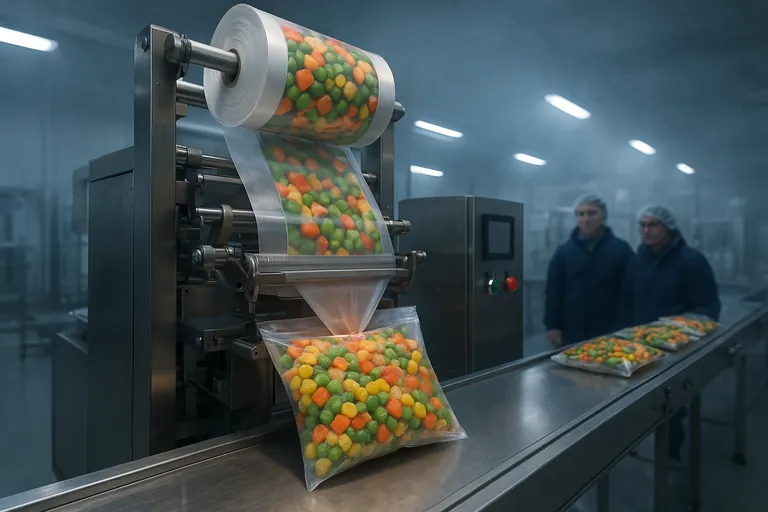
We almost always get good results on existing VFFS/HFFS. The changes are tweaks, not overhauls.
- Sealing window: Start 125–145°C on jaws with mLLDPE sealant, dwell 400–600 ms. PET/PE habits run hotter and faster. Slow down first, then optimize.
- Jaw pressure: Increase 10–20% vs PET/PE to compensate for PE’s softness.
- Hot tack: Metallocene LLDPE beats LDPE. EVA (2–6%) can widen the window further. If you’re chasing speed, mLLDPE + a touch of EVA is a friendly combo.
- Cold crack and impact: Aim for ASTM D1709 dart impact >200 g at -18°C for 1 kg bags. Do five-position drops from 1.2 m at -23°C. Expect >95% pass rate on the spec above.
- Knife and collar: PE is “gummier” than PET. Keep knives sharp and consider anti-static bars at the forming tube to reduce cling.
- Product conditioning: Dehumidify the room around the jaw area. Surface frost on film kills seals faster than any material choice.
Printing practice:
- Use PE inks and, when laminating PE/PE, solventless adhesive with PE compatibility. Avoid inks with high metal content to keep recyclability cleaner.
- For strong reds and yellows, remember pigments can show through on pale veg like Frozen Paprika (Bell Peppers). Ask your printer for a PE-based opaque white underlayer.
Phase 7–12: Scale and optimize
Once the bag passes drop and peel tests, you can safely optimize for cost and speed.
- Thickness trimming: Step down by 5–10 μm in trials. If drop performance holds, bank the resin savings.
- MDO-PE grade upgrade: Newer MDO-PE films in Indonesia have better stiffness at the same gauge. That helps stand-up pouches stand up without PET.
- Zipper choice: Use mono-PE zippers. Width 8–10 mm is a sweet spot for 500 g–1 kg. PE zippers keep the pack in the PE recycling stream. Don’t use PP zippers if you want to claim mono-PE.
We’ve seen 10–15% cycle-time gains after teams dial dwell and jaw pressure for mLLDPE. Most improvements come in week two of full production when operators trust the lower temperature setpoints.
The biggest mistakes we keep seeing (and how to avoid them)
- Over-specifying barrier. For straight IQF veg, OTR and MVTR needs are modest. 100 μm PE typically has OTR 2,000–4,000 cc/m²/day at 23°C and WVTR 0.4–0.8 g/m²/day at 38°C/90% RH. At freezer temps, both drop dramatically. Save EVOH for odor-prone items like onion or garlic blends.
- Ignoring zipper recyclability. A PP zipper breaks the “mono” claim. Choose recyclable PE zippers and PE-compatible inks.
- Chasing PET-like stiffness without MDO. Plain LDPE/LLDPE feels floppy. Add an MDO-PE outside web or a light PE/PE lamination for shelf impact.
- Skipping cold conditioning. Test seals and drops after 24 hours at -23°C, not at room temp. Real-world failures happen cold.
Quick answers to what buyers ask us most
Are mono-PE bags strong enough for 1 kg frozen vegetables?
Yes. With 85–100 μm total and an MDO-PE outer plus mLLDPE/EVA sealant, we meet 1.2 m drop tests at -23°C on 1 kg packs for products like our Premium Frozen Potatoes and Frozen Mixed Vegetables.
What thickness should I use for mono-PE IQF vegetable bags?
- 400–500 g: 70–80 μm on VFFS.
- 1 kg: 85–100 μm on VFFS.
- Stand-up pouches: 90–120 μm depending on gusset and shelf stiffness goals.
Do IQF vegetables need an EVOH barrier in PE packaging?
Usually no. Add EVOH only for odor-sensitive mixes (onion-heavy blends) or if your customer mandates a stated OTR target. Keep EVOH at 3–5% in a PE/EVOH/PE coex to maintain recyclability claims.
Can I use a recyclable PE zipper and still keep the bag recyclable?
Yes. Use a mono-PE zipper and PE inks. Keep non-PE components below the thresholds in your destination market’s design-for-recycling guidance.
Will mono-PE run on my existing VFFS/HFFS pouch line without major changes?
Yes. Expect lower jaw temperatures, slightly longer dwell, and higher pressure. You may add anti-static and sharpen knives. No major hardware swaps needed for most 2015+ lines.
How do I print high-quality graphics on mono-PE bags with Indonesian suppliers?
Rotogravure delivers the best coverage and fine type for 15k+ runs. Digital suits pilots and frequent artwork changes. Make sure the PE film is treated to 38–42 dynes and spec a PE-based white underlayer for vivid colors.
Is mono-PE acceptable for EU recyclability claims in 2026?
In general, yes. Many EU markets apply eco-modulation with lower EPR fees for mono-material PE flexible packs. Requirements vary by country. Maintain >90% PE by weight, avoid incompatible zippers/inks, and verify with your local PRO.
How to test cold crack resistance at -18°C
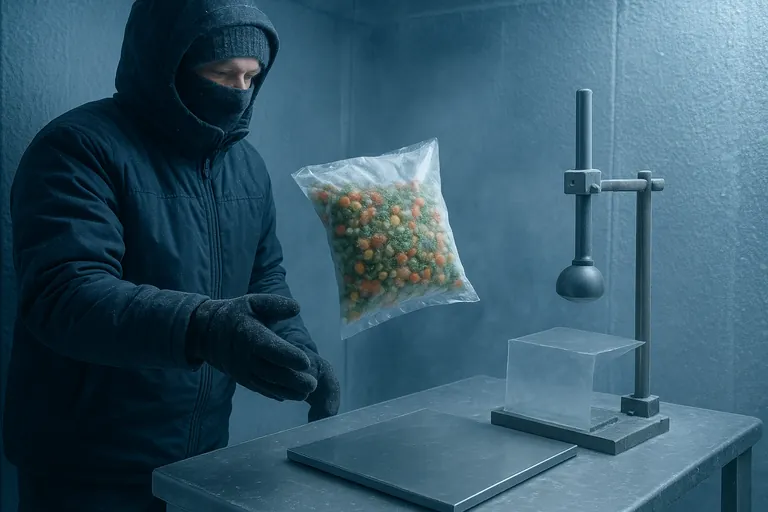
- Condition rollstock and filled bags at -23°C for 24 hours.
- Perform ASTM D1709 dart impact at -18 to -23°C; target >200 g for 1 kg packs.
- Run five-position drop tests from 1.2 m at -23°C, 5 drops/bag. Goal: zero seal ruptures.
- Optional: Gelbo flex (ASTM F392) at cold temp to check crazing of printed layers, especially on heavy ink coverage.
Sample RFQ spec you can copy and paste
- Bag style: VFFS pillow, 1 kg net. Final size 240 × 340 mm.
- Structure: MDO-PE 35 μm // mLLDPE/EVA sealant 55 μm. Total 90 μm. Mono-PE.
- Barrier: None. Alternate quote: PE/EVOH/PE with 4% EVOH core.
- Additives: 1,500 ppm silica anti-block outer, 700 ppm erucamide slip outer.
- Treatment: 40 dynes print side.
- Printing: Rotogravure, 8 colors, PE-based inks with opaque white underlayer.
- Zipper: Mono-PE 9 mm, compatible with PE recycling stream.
- Seal requirements: Fin seal 10–14 N/15 mm, top/bottom 6–10 N/15 mm (ASTM F88).
- Impact/cold: Dart impact >200 g at -18°C. Drop test 1.2 m at -23°C, 5 positions, no failures.
- Line settings reference: 135°C jaws, 500 ms dwell, medium-high pressure. To be tuned on site.
- Carton: 10 kg master, printed shipper. Palletization as per buyer spec.
If you want us to sanity-check your RFQ or match it to an Indonesian co-packer timeline, Call us and we’ll help you avoid the usual back-and-forth.
Where mono-PE makes the biggest impact now
We’re seeing fast wins on SKUs like Premium Frozen Sweet Corn, Premium Frozen Edamame, and Frozen Mixed Vegetables. Colorful items like Frozen Paprika (Bell Peppers) also convert well once the print white layer is dialed in. You’ll feel the trade-up on shelf while keeping the pack in the PE recycling stream.
Bottom line. If your 2026 brief includes “recyclable frozen food packaging,” mono-PE is ready. Start with the spec above, validate cold, and then optimize for speed and gauge. We’ve done it in Indonesia, and we’re happy to walk you through your first run.