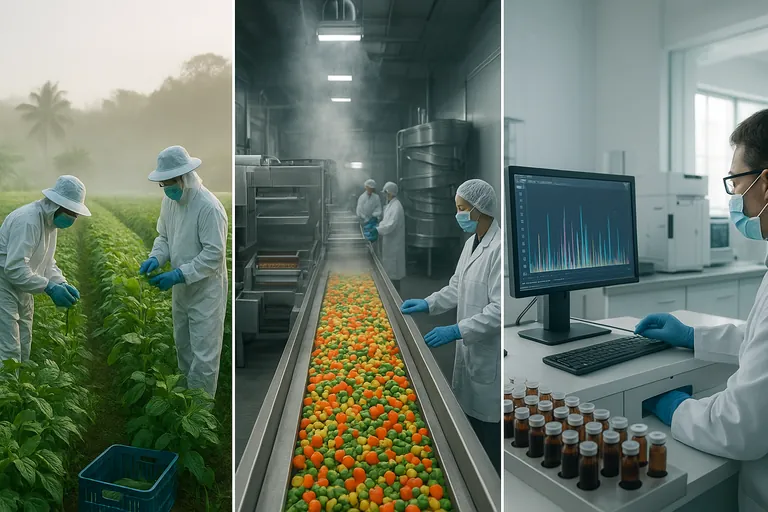
A step-by-step, procurement-ready workflow to verify EU MRL compliance for Indonesian IQF vegetables in 2026. We cover risk-based sampling, choosing ISO 17025 labs, interpreting pesticide COAs, hold-and-release, and enforceable contract clauses.
If you buy IQF vegetables for the EU, you already know one missed pesticide can sink a season. We’ve helped buyers go from sporadic border holds to clean records in a single quarter by tightening the compliance workflow before booking. Here’s the exact, procurement-ready system we use for Indonesian IQF vegetables in 2026.
The 3 pillars of an EU-proof MRL program
- Pillar 1. Risk mapping and supplier control. Know your crop risks, farm practices, and history. Tie every lot to farms and spray records.
- Pillar 2. Lab verification that stands up at EU border. Use ISO/IEC 17025 labs with the right scope, LOQs, and decision rules. Validate the COA, don’t just file it.
- Pillar 3. Governance that bites. Hold-and-release, action limits below MRLs, and contract clauses that shift cost and behavior.
We apply the same pillars to our own lines. For example, our Premium Frozen Okra and Frozen Mixed Vegetables (with green beans, peas, carrots, corn) run through this workflow every season.
Weeks 1–2: Risk research and supplier validation (tools + templates)
Start with a short, sharp risk assessment per crop, supplier, and season.
- Crop risk. In Indonesia, high-risk IQF items for the EU are green beans, okra, leafy spinach, and some herbs. Lower risk: sweet corn, edamame, paprika/bell peppers. Typical exceeders we watch: acephate/methamidophos, profenofos, chlorpyrifos (EU default 0.01 mg/kg), lambda-cyhalothrin/cypermethrin, carbendazim/thiophanate-methyl, and dithiocarbamates (as CS2).
- Supplier history. Score each supplier: last 12 months pass rate, corrective actions closed, farm count stability, and any RASFF mentions.
- External signals. Check the RASFF portal weekly for “pesticide” plus “Indonesia” plus your crop. If your crop-country combo pops up twice in a month, tighten testing to every lot for that period.
Practical takeaway: Build a one-page risk matrix. Red = every-lot testing. Amber = 1-in-3 lots after five consecutive passes. Green = 1-in-10 verification. Any change of farm, season start, or pesticide program bumps a supplier back to red for three lots.
Need help tailoring a sampling plan to your crops and buyer specs? Feel free to Contact us on whatsapp. We can share the exact template we use.
Weeks 3–6: Sampling and lab testing rollout
How many subsamples should I take per lot for pesticide residue testing?
For homogeneous IQF, we target:
- Lot definition. One production day and continuous run per SKU, per farm group, max 20 MT.
- Incremental samples. 30 increments per lot across at least 5 pallets, top-middle-bottom layers, 100 g each. Aggregate to a 3 kg sample. If 30 increments aren’t feasible, use a minimum of 10 spread increments and document the rationale.
- Lab test portions. The lab will take representative test portions (typically 10–15 g) from the homogenized sample for LC-MS/MS and GC-MS/MS.
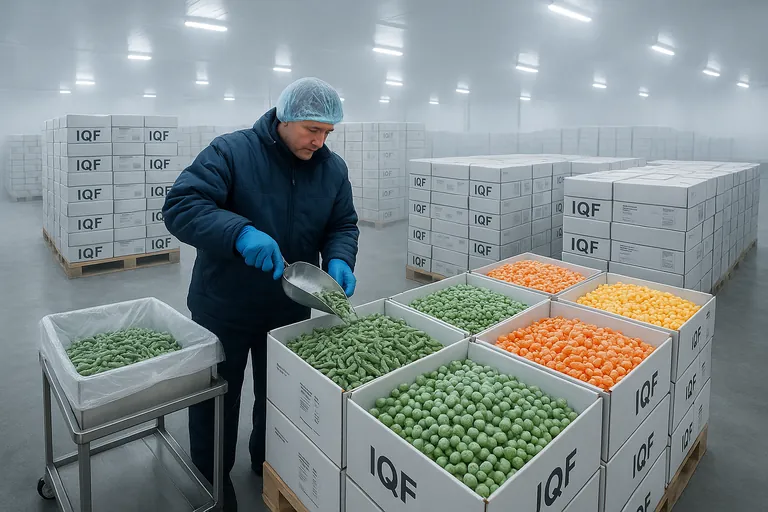
Why 30 increments? It catches farm-to-farm variability, especially in mixed-farm supply. I’ve seen a single outlying pallet blow a pass rate when buyers only sampled two boxes.
Choosing the right lab: ISO 17025 the right way
Use ISO/IEC 17025:2017 accredited labs with KAN accreditation for “Vegetables and vegetable products.” Verify three things:
- Scope and LOQs. Multi-residue QuEChERS LC-MS/MS and GC-MS/MS with LOQs at 0.01 mg/kg for most analytes. Add specific methods for dithiocarbamates (CS2), glyphosate/AMPA, and ethylene oxide if required by customers.
- Decision rule. The lab should apply EU MRLs under Reg. 396/2005 and state conformity with measurement uncertainty considered. If no decision rule is shown, ask for it.
- Turnaround and capacity. Standard TAT in Indonesia is 5–7 working days for 200–500 analytes. Rush is 3–4 days with a surcharge. Budget IDR 1.8–3.5 million per sample for multi-residue plus IDR 0.5–1.0 million for dithiocarbamates.
What documents prove EU MRL compliance for IQF vegetables?
- ISO 17025 pesticide residue COA. With accreditation mark, sample identification matching your lot, method details, LOQs, results in mg/kg, measurement uncertainty, and pass/fail against EU MRLs.
- Traceability packet. Production records linking farms to the lot, blanching and freezing records, and a packing list referencing the same lot code as the COA.
- Farm spray records. Pesticide program, last spray dates, PHIs observed.
In our experience, border officers move quickly when the COA clearly ties to the commercial lot and the lab scope is unambiguous.
Weeks 7–12: Hold-and-release, scaling, and optimization
What is a solid hold-and-release procedure?
- Block lots physically and digitally. IQF pallets are flagged “QA Hold” until QA signs off with a valid COA.
- Keep a retained sample. 1 kg sealed retain per lot at -18°C for 6 months beyond shelf life or per contract.
- Set action limits below EU MRLs. We use 70% of the EU MRL as our internal action limit. For default 0.01 mg/kg substances (like chlorpyrifos), our action limit is 0.005–0.007 mg/kg.
- Near-MRL results. If a residue is between 70–100% of MRL, we retest on a second aliquot and consider measurement uncertainty before release.
Do I need to test every shipment or run risk-based testing?
Both. Start with 100% per-lot testing for new crops, new seasons, or supplier changes. After five consecutive passes with stable farms and spray programs, step down to 1-in-3 lots. Maintain 1-in-10 verification for low-risk items like Premium Frozen Sweet Corn and Frozen Paprika (Bell Peppers). Any RASFF alert or farm change resets to 100%.
The questions buyers ask us most
Which pesticides most often exceed MRLs in Indonesian green beans, okra, or spinach?
- Green beans and okra. Acephate and its metabolite methamidophos, profenofos, lambda-cyhalothrin/cypermethrin, and dithiocarbamates. Chlorpyrifos remains the number-one red flag in audits even after its EU non-approval. The MRL is effectively the default 0.01 mg/kg.
- Spinach/leafy greens. Dithiocarbamates, carbendazim/thiophanate-methyl, and pyrethroids. Emamectin benzoate can appear with tight MRLs.
We watch RASFF alerts weekly to adjust panels and action limits.
Does blanching change which EU MRLs apply to IQF vegetables?
MRLs in the EU are set mainly for raw commodities. For processed foods, authorities apply processing factors if EFSA has established them. For blanched IQF, residues often drop, but enforcement will either use a published processing factor or assume 1 if none exists. Bottom line. Don’t rely on blanching to fix an exceedance. Your raw material and final IQF product both need to be compliant.
How do I verify an ISO 17025 pesticide COA is valid and complete?
Run a 9-point check:
- Lab accreditation mark and number. 2) Sample description matches your lot, product name, and matrix (e.g., “IQF okra, blanched”). 3) Unique sample ID that appears on your chain-of-custody. 4) Date of sample receipt and analysis. 5) Methods listed, typically QuEChERS LC-MS/MS and GC-MS/MS, plus CS2 for dithiocarbamates. 6) LOQs shown and at or below 0.01 mg/kg. 7) Results in mg/kg with “<LOQ” where non-detect. 8) Measurement uncertainty and decision rule. 9) Signature of authorized signatory and page numbers. If any of these are missing, border officers may question the report.
How to read a pesticide COA for frozen vegetables in practice
Scan the analyte list for known local actives. If you see chlorpyrifos at 0.008 mg/kg, that’s below the 0.01 mg/kg default MRL but too close for comfort. We’d classify this as “amber,” trigger a supplier CAPA, and keep testing every lot. If dithiocarbamates show 0.09 mg/kg (CS2) and the MRL for your crop is 0.05 mg/kg, that’s a fail even if everything else is clean.
Steps to handle an MRL exceedance at the EU border
- Freeze movement immediately. Inform the importer, forwarder, and supplier. Hold similar lots.
- Engage the lab. Request re-analysis on the retained test portion. Consider a second accredited lab for confirmation.
- Decide disposition. Re-export to a non-EU market with legal limits, or destruction under authority supervision. Reprocessing rarely solves systemic pesticide exceedances.
- Root cause and CAPA. Audit the farm spray program, PHIs, and applicator training. Tighten action limits and test frequency. Update your risk matrix.
- Expect increased controls. Monitor Implementing Regulation 2019/1793 updates. A single RASFF can trigger lots of extra paperwork.
What about “EU MRL limits for frozen green beans 2026” or “chlorpyrifos MRL frozen vegetables EU 2026”?
MRLs change. Always check the EU Pesticides Database for your exact commodity code and residue definition. As of now, chlorpyrifos is non-approved and the practical MRL for most commodities is the default 0.01 mg/kg. Verify again before each season.
Contract clauses that actually work
We’ve found that contracts do more than labs to keep programs clean.
- Regulatory reference. Supplier warrants compliance with Regulation (EC) 396/2005 and amendments for the EU market.
- Pre-shipment testing. Supplier must provide an ISO/IEC 17025 COA per lot covering an agreed multi-residue panel with LOQs ≤0.01 mg/kg, including dithiocarbamates (CS2). Hold-and-release applies until buyer approval.
- Traceability and transparency. Farm IDs, spray records, and harvest dates per lot. Any change in farm sources requires 72-hour prior notice and resets testing to 100% for three lots.
- Cost and liability. In case of non-compliance, supplier covers testing, demurrage, disposal, and re-export costs. Repeated failures allow contract termination.
- Audit rights. Buyer may audit farms and facilities with reasonable notice.
Put these in plain language. If suppliers push back, that’s your early-warning signal.
Two non-obvious tactics that save headaches
- Use action limits by chemistry. We set stricter internal limits for actives with tight MRLs or unstable degradation, like methamidophos. A flat “70% of MRL” is a start, but chemistry-specific limits catch more issues.
- Split-lot strategy for mixed farms. When aggregating raw material from multiple farms, create sub-lots per farm group and test them separately. If one group fails, you don’t lose the entire production day.
Resources and next steps
If you want a working example of this system, look at how we manage Frozen Mixed Vegetables and Premium Frozen Okra. Same farms, same labs, same governance every season. Questions about your project timeline, test panels, or contract wording? Contact us on email and we’ll share sample SOPs and an editable risk matrix.
Quick recap you can act on today:
- Map risks by crop, supplier, and season. Adjust frequency based on RASFF and history.
- Sample 30 increments per lot. Use ISO 17025 labs with LOQs at 0.01 mg/kg and clear decision rules.
- Enforce hold-and-release with action limits below MRLs. Put teeth in your contracts.
Get those three right and you’ll feel the difference the next time a container hits the EU border. And yes, that’s when people bookmark your supplier checklist.