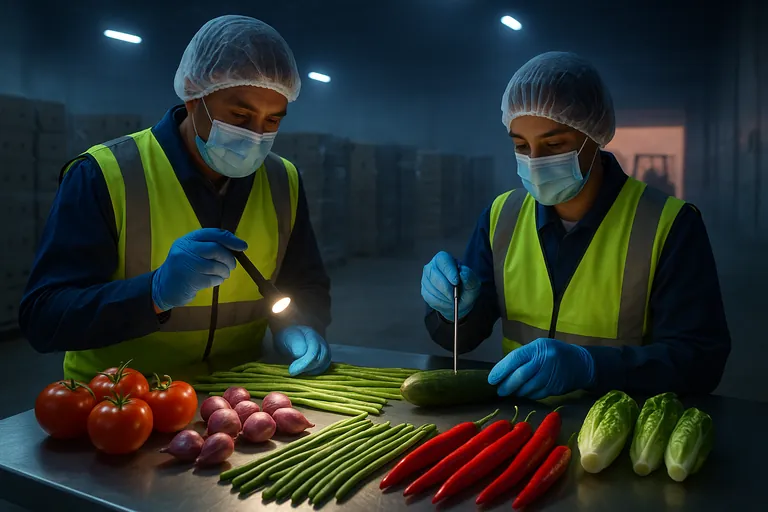
A practical, exporter-first playbook for Indonesian packers on the FSMA 204 traceability lot code. Exactly what to print on consumer packs, cases, and bulk bins for cucumbers, tomatoes, and leafy greens by January 20, 2026. Includes formats, examples, and how this code flows when U.S. partners repack.
If you trade Indonesian vegetables into the U.S., the single most confusing part of the FDA Food Traceability Rule (FSMA 204) is the on-label traceability lot code. We get asked every week where it has to go, who assigns it, and whether a QR code is enough. Here’s the straight answer from the factory floor.
This piece is label-only. We focus on how to assign and print the FSMA 204 traceability lot code for vegetables on the Food Traceability List (FTL) by January 20, 2026. Think cucumbers, tomatoes, and leafy greens like baby romaine and loloroso. Not all veg are covered, and we’re not touching EU/UK nutrition or full recordkeeping here.
The 3 pillars of FSMA 204 on-label compliance
-
Assign one valid traceability lot code at the right moment. For produce, the “traceability lot code source” is usually the initial packer. If you pack retail or foodservice units in Indonesia, you assign it. If product arrives loose and the first land-based receiver in the U.S. does the initial packing, they assign it.
-
Put the code on every consumer unit when the food is packaged for retail sale. And always put it on the outer case, pallet tag, or bulk bin label that physically carries the product through distribution.
-
Link that code to the Key Data Elements at each Critical Tracking Event. The label holds the code. Your records hold the who, what, when, and where behind it. The code should stay unchanged through distribution unless someone repacks, commingles, or otherwise transforms the product.
Practical takeaway. If you export Japanese Cucumber (Kyuri), Tomatoes, or leafy greens like Baby Romaine and Loloroso (Red Lettuce) in finished consumer packs, expect to print the traceability lot code on each unit and mirror it on the case.
What to print where: consumer pack, case, and bulk bins
Do I have to print the FSMA 204 traceability lot code on each consumer pack, or only on the case?
If the item is packaged for retail sale, yes, print the traceability lot code on each consumer pack. If the item is shipped loose for repacking in the U.S., then the traceability lot code must appear on the immediate container that moves through the chain. That means the master case, RPC label, or bin tag. If it is retail-ready, do both.
We recommend a small text line on the consumer label. Example: Traceability Lot Code: IV-KYU-250101-A1. Keep it simple and legible.
What exact fields should appear on a master case label to meet FSMA 204 expectations?
FSMA 204 requires the traceability lot code to be on the food label when packaged and to flow on shipping documents. The regulation doesn’t mandate a long list of case label fields. That said, buyers expect a minimum professional standard. We use two tiers.
Must have on the case label:
- Product name and variety. Example: Cucumber, Japanese Kyuri
- Traceability Lot Code. Exact text used on the consumer pack
- Packer name and address. The entity assigning the code
Strongly recommended for speed during recalls and receiving:
- GTIN or item code
- Pack date or date code (YYYYMMDD or YYMMDD)
- Net weight or count
- Growing region and farm ID or code
- Optional barcode encoding of the same data (GS1-128)
This keeps you compliant while making your cases scannable and intelligible on any dock.
Acceptable formats and barcoding
Can a QR code or GS1-128 barcode satisfy the FSMA 204 lot code requirement?
Yes. FSMA 204 allows flexibility. You can present the traceability lot code as plain text, a barcode, or both. In our experience, both is best. Human-readable text prevents delays when scanners fail. A scannable symbol speeds throughput.
For GS1 users, encode the traceability lot code in Application Identifier (10). A typical GS1-128 case label might include:
- (01) GTIN
- (10) Traceability Lot Code
- (13) Pack date
- (37) Case count
Example string: (01)10812345000017(10)IV-KYU-250101-A1(13)250101(37)12. Printing the same lot code in clear text right below the barcode helps receivers who don’t have GS1-ready scanners. QR is fine too if it resolves to a data page that clearly displays the same lot code and product metadata.
Practical takeaway. Whatever barcode you choose, ensure the exact same alphanumeric lot code is visible as text on the label.
Who assigns the code and how it maps to harvest lots
Who assigns the traceability lot code for Indonesian vegetables shipped to the U.S.?
When we pack consumer or foodservice units in Indonesia, we assign the code at initial packing. If we ship loose product and a U.S. partner performs the initial packing, they become the code source. For imports, the first land-based receiver keeps the code flowing in their records and shipping docs. They only create a new code if they transform or repack.
How is a traceability lot code different from our existing production lot or batch number?
Many exporters already use internal batch codes. FSMA 204’s traceability lot code can be your existing batch code if it uniquely identifies the traceability lot and links to the required KDEs. The difference is scope. Your production lot might group by shift or line. The traceability lot must resolve quickly to harvest area or source, harvest date range, and packer identity for that specific food. If your current code spans multiple fields or dates without precise linkage, create a new FSMA 204 lot code or tighten your mapping.
A simple, durable format we like: Company-Food-Abbrev-PackDate-FarmCode-Sequence. Example: IV-TOM-250115-BDG03-02. It’s human-friendly, globally unique in your system, and easy to map to KDEs.
Mapping Indonesian harvest lots to the FDA traceability lot code
At harvest, capture farm block, harvest date, crew, and field lot. At packing, link incoming field lots to pack runs and generate the traceability lot code for each pack run. Don’t merge distinct field lots under one code unless you intend to treat them as one traceability lot end-to-end. A little discipline here avoids headaches later.
Repacking, mixing, and special cases
What happens to the lot code if a U.S. re-packer mixes or re-labels the vegetables?
That’s a transformation under FSMA 204. The U.S. re-packer must assign a new traceability lot code and keep KDEs that link the new code back to every source code used. Your original code should appear on the inbound documentation and packaging they receive. Their new labels will show their new code going forward.
Do bulk bins of vegetables need a traceability lot code tag?
Yes. If a pallet bin or RPC is the unit moving through the chain, attach a durable tag or label with the traceability lot code. Make it weather-resistant and readable after condensation and handling.
Exemptions and edge cases
Are small farms or low-volume exporters exempt from printing the lot code on labels?
FSMA 204 includes some exemptions and partial exemptions, especially for entities outside the Produce Safety Rule’s scope or direct-to-consumer sales. In practice, if you export to U.S. wholesalers or retailers, you should plan to comply. Even when a technical exemption might apply, your buyer contracts will likely require a traceability lot code on labels and in docs. We recommend treating the labeling requirement as non-negotiable for FTL foods.
If your situation is unusual, we’re happy to sanity check your approach. Need help tailoring your labels or barcodes to a buyer spec? You can Contact us on whatsapp.
Practical examples with Indonesian vegetables
-
Retail-pack Japanese Cucumber (Kyuri). Print the traceability lot code on each sleeve or sticker, and duplicate on the case. Sample consumer text: Traceability Lot Code: IV-KYU-250101-A1. Sample case GS1-128: (01)10812345000017(10)IV-KYU-250101-A1(13)250101(37)20.
-
Vine-ripe Tomatoes in 1 lb clamshells. Each clamshell carries the same code, reflected on the case. If loose tomatoes ship in RPCs for U.S. repacking, put the traceability lot code on the RPC label and bills of lading.
-
Leafy greens like Baby Romaine and Loloroso (Red Lettuce). If you trim and bag in Indonesia, the consumer bag must show the code. If you bulk-pack heads for U.S. processing, label the case and bin with the code.
Not all other items we export require FSMA 204 lot codes. Carrots, onions, radish, eggplant, beetroot, and most frozen vegetables are not on the FDA’s Food Traceability List. Always align with your buyer’s spec and current FDA guidance.
Sample master case label text
Packer: PT FoodHub Collective Indonesia, Bandung, ID Product: Tomato, Round, 5x6 Traceability Lot Code: IV-TOM-250115-BDG03-02 Pack Date: 2025-01-15 Farm: BDG03 GTIN: 10812345000017
Your 2026 readiness sprint
- Weeks 1–2. Inventory your FTL items and decide who is the initial packer per SKU and flow. Lock the traceability lot code format and where it prints on consumer packs and cases. Create a one-page label spec.
- Weeks 3–6. Update artwork and print plates. Configure GS1-128 or QR if using barcodes. Train packing teams. Run a live mock shipment with proper labels and shipping docs carrying the same code.
- Weeks 7–12. Stress-test repack scenarios with your U.S. partners. Confirm how your code flows on ASNs, invoices, and BOLs. Do a mock recall drill. You should be able to identify one day’s worth of production in minutes using only the traceability lot code and your KDEs.
What’s interesting is the fix is usually small. Most teams already print a batch code. The win comes from aligning that code with FSMA 204 expectations and putting it exactly where receivers expect to see it.
Quick takeaways you can apply today:
- If it’s retail-pack FTL produce, print the traceability lot code on each unit and on the case.
- Keep the same code in human-readable text even if you add a barcode.
- Initial packer assigns the code. Repackers who change the product assign a new one and link back.
- Don’t overcomplicate the format. Make it unique, scannable, and easy to map to harvest and pack data.
If you need a second set of eyes on your cucumber or leafy greens labels, we can review a PDF or photo and suggest practical fixes same day. Or explore our current export lineup here: View our products.