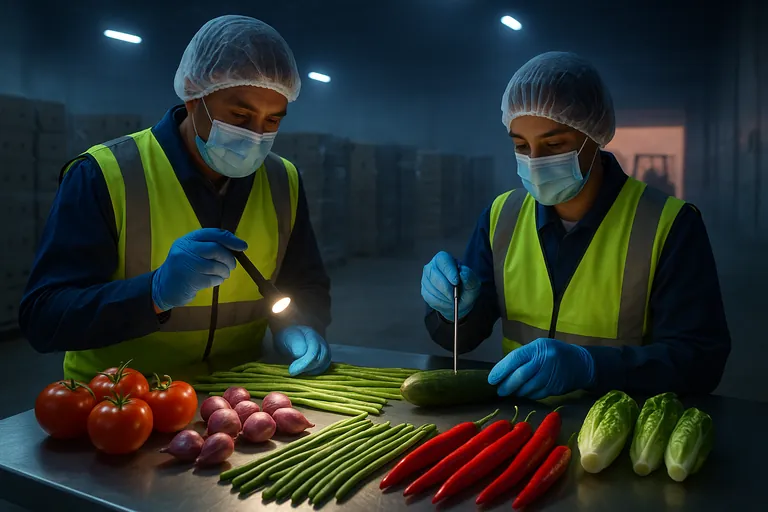
A practical, bookmarkable playbook for setting AQL plans on Indonesian fresh vegetables. Real defect lists, c=0 vs c=1 decisions, ANSI/ASQ Z1.4 sample sizes, and worked examples for 20-foot mixed containers.
If you’ve ever argued over “how many defects is too many?” on a loading dock at midnight, this guide is for you. We’ve spent years aligning buyer specs with what Indonesian packhouses can consistently deliver. Below is the exact framework we use to set AQL for Indonesian vegetables. It’s focused on post‑harvest visual and packaging quality. Not lab tests, MRLs, GAP, or paperwork.
What AQL is realistic for Indonesian fresh vegetables?
Here’s the thing. Produce breathes, sweats, and changes by the hour. An AQL that works for retail-ready baby romaine won’t work for onions bound for processing.
- Premium retail lines and ready-to-eat leaves (e.g., Baby Romaine): Critical 0.0. Major 1.5–2.5. Minor 4.0.
- Mainstream retail robust veg (e.g., Tomatoes, Onion, Carrots): Critical 0.0. Major 2.5–4.0. Minor 6.5.
- High-variability crops and mixed growers during rainy weeks: keep critical 0.0, nudge major up one notch (e.g., 3.2 or 4.0) and hold minor at 6.5. Then tighten once weather stabilizes.
Our rule: hold critical at zero. Tune majors to the product risk and your brand promise. Use minors to manage appearance without rejecting sound produce.
Practical takeaway: Put those three numbers in your PO and supplier agreement for every SKU. If the target market changes, update the AQL before harvest, not after loading.
c=0 vs c=1: which should you use?
We get this question weekly. Here’s the short answer, based on what actually protects you without causing chaos in the packhouse.
- Critical defects: always c=0. Foreign matter, live insects, wet rot, food safety risks. One is enough to fail.
- Major defects: c=0 for ready-to-eat leaves and high-brand-risk items. c=1 for robust veg where a single major in a large sample shouldn’t sink the lot.
- Minor defects: c=1 or c=2 depending on your shelf-life buffer and promo calendar. We rarely go beyond c=2 for minors in fresh veg.
Why? c=0 forces better upstream sorting and fewer “near misses.” c=1 on majors balances fairness with risk for items like Tomatoes and Onion.
Applying ANSI/ASQ Z1.4 (MIL‑STD‑105E) to vegetables
Use the standard to decide how many cartons to open. Then define how many pieces per carton you’ll check.
Step-by-step:
- Define the lot. Same SKU, grade, pack date, and packhouse equals one lot. Mixed SKUs are separate lots.
- Choose General Inspection Level II. It’s the industry workhorse for fresh produce.
- Find your code letter. Example: lot size 1,201–3,200 cartons → code letter K.
- Read the sample size. Code K → 125 cartons to sample under “single sampling, normal inspection.”
- Decide your acceptance rule. Either use a simplified c=0/c=1 plan or look up Ac/Re in the Z1.4 table for your chosen AQL.
- Inside each selected carton, pull pieces for piece-level checks. We typically target 200–315 total pieces across the sample for robust statistics.
Example implementation:
- Carton-level checks (labels, net weight, carton crush, temperature): unit = carton. Sample size from Z1.4 (e.g., 80, 125, 200 cartons depending on lot size).
- Piece-level checks (bruising, decay, size): unit = piece. If you sampled 125 cartons, pull 2–3 pieces per carton to reach ~250–315 total pieces.
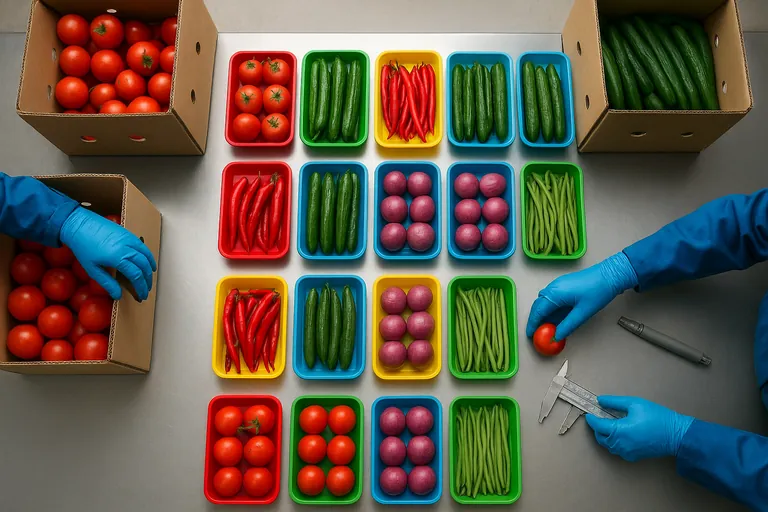
Note on Ac/Re numbers: With n=125 and the Z1.4 single-normal table, AQL 1.5% commonly maps to Ac around 3 and Re 4, and AQL 4.0% around Ac 10 and Re 11. Always confirm with the current table or a trusted AQL calculator.
How many cartons should I sample in a 20‑foot container of mixed vegetables?
A 20-foot reefer usually holds 10–12 pallets, often 800–1,200 cartons total. But you sample per SKU lot, not per container total.
Typical mixed load example:
- 400 ctn Red Cayenne Pepper → lot size 281–500 → code H → sample 50 cartons.
- 220 ctn Japanese Cucumber (Kyuri) → 151–280 → code G → sample 32 cartons.
- 150 ctn Onion → 91–150 → code F → sample 20 cartons.
- Micro-lot 30 ctn Baby Romaine for a promo → 26–50 → code D → sample 8 cartons. If the item is high risk, we often go 100% visual scan on outer layers.
Pro move: If you have many micro-lots under 50 cartons, set a floor like “minimum 8 cartons per SKU” and 100% checks for anything under 10 cartons. Document this in the PO.
Worked example: AQL plan for a 6,000‑carton program
Say you’re shipping 6,000 cartons of Tomatoes across several reefers in one sailing window.
- Treat each sailing day or pack date as a separate lot. Assume one lot = 1,800 cartons.
- Z1.4 Level II: 1,201–3,200 → code K → sample 125 cartons.
- Carton-level AQL: Major 2.5, Minor 6.5. Use c=1 for majors, c=2 for minors if you prefer the simplified rule. Or use Z1.4 Ac/Re for 125 cartons if you follow the formal plan.
- Piece-level: Pull 2 pieces per selected carton → 250 pieces total. Major 2.5 with c=1. Minor 6.5 with c=2. Critical c=0 at both carton and piece level.
If you need help adapting this to your SKUs and shelf-life targets, reach out and we’ll map it in 20 minutes. Need a sanity check on your numbers? Contact us on whatsapp.
What counts as critical, major, minor? (Chili, shallots, long beans)
These are field-tested thresholds we use with Indonesian packhouses. Adjust to your buyer spec.
- Critical: live insects, glass/metal/wood, wet rot or leaking decay, chemical or fuel odor.
- Major: anthracnose lesions or mold spots >5 mm, soft/ mushy pods, shrivel >20% surface, color off-spec (>20% green on “red” chili), broken stem when “with stem” required, severe mechanical cuts exposing seeds.
- Minor: superficial scuffing or healed scars <5 mm, light curvature, slight color non-uniformity, minor dryness at calyx.
Shallots (applies similarly to Onion)
- Critical: internal wet rot, maggots/live insects, foreign matter, extensive mold affecting adjacent bulbs.
- Major: sprouting, soft neck/soft spots, severe mechanical damage exposing flesh, size out-of-grade beyond tolerance, double bulbs when single required, thick greened scales visible.
- Minor: loose skins, slight misshape, minor staining/soil, light skin peel with intact flesh.
Long beans (yard‑long beans)
- Critical: live insects, wet rot, heavy mold that spreads.
- Major: broken pieces below minimum length, severe scarring or insect holes, bulging seeds indicating over‑maturity, dehydrated/limp pods, color yellowing >20%.
- Minor: light surface scarring, slight curvature beyond “straight” but still packable, minor tip bruise without leakage.
Piece-level vs carton-level: how to avoid double counting
In my experience, most disputes come from mixing units. Keep it clean.
- Carton-level defects: labeling errors, net weight short, carton crush, no vents, wrong count. Unit = carton. Sample size from Z1.4.
- Piece-level defects: decay, bruising, size/shape/color. Unit = piece. Aggregate across all opened cartons until you hit 200–315 pieces.
- Don’t convert piece defects into “carton fails.” A single bruised cucumber is one piece defect, not a failed carton.
Carton inspection checklist you can use today
- Outer packaging: intact, no crush or water damage. Correct carton spec and ventilation holes present.
- Labeling: product name, variety, grade, net weight, pack date, lot/trace code, country of origin.
- Net weight/count: weigh at least 10 cartons per SKU. Tolerance ±1–2% unless otherwise agreed.
- Temperature: pulp and ambient at doors and center. Record on the QC sheet.
- Internal packaging: liners, absorbent pads, dividers as specified. No free water.
- Palletization: height, tie sheets, corner boards, wrap tension, pallet condition.
- Ethylene compatibility and segregation as per your load plan.
How do Indonesian SNI standards relate to buyer specs and AQL?
SNI gives minimum grade definitions and tolerances. Many premium buyers run tighter specs for uniformity and presentation. We use SNI as the floor and the buyer spec as the ceiling, then translate that ceiling into an AQL plan.
Practical approach:
- Start with the buyer spec (e.g., straightness and uniform color for Japanese Cucumber (Kyuri)).
- Map each defect to critical/major/minor with numeric thresholds.
- Choose AQLs by risk tier as above.
- Select Z1.4 sample sizes for cartons and set a fixed piece sample target.
- Document switching rules: tighten after two consecutive rejects; return to normal after five consecutive accepts.
Supplier agreement wording that works: “Seller agrees to ANSI/ASQ Z1.4, General II, single normal. Lot unit = carton. Carton-level AQL: Critical 0.0 (c=0), Major 2.5 (c=1), Minor 6.5 (c=2). Piece-level sample ≥250 units per lot with identical acceptance numbers. Critical defects cause immediate lot failure.”
Common mistakes we still see (and quick fixes)
- Mixing SKUs into one lot. Fix: lot = SKU × pack date × packhouse. Sample each.
- Checking “some boxes” without a plan. Fix: pick the code letter and commit to the sample size. No cherry‑picking pallets.
- Counting one bruised piece as a failed carton. Fix: separate carton vs piece units.
- Ignoring temperature in the QC. Fix: record pulp temps. A visually “OK” lot at 10°C will fail on shelf.
- Setting majors too tight in rainy weeks. Fix: hold critical at 0, relax majors one notch for 1–2 weeks, then tighten.
What’s interesting is how fast this reduces noise. Three out of five teams we coach cut disputes by half in a month just by separating carton and piece counts.
If you want us to sanity-check your defect list for a specific SKU like Red Cayenne Pepper or Baby Romaine, we’re happy to share templates. Questions about your next load? Call us. Or browse what we ship today: View our products.