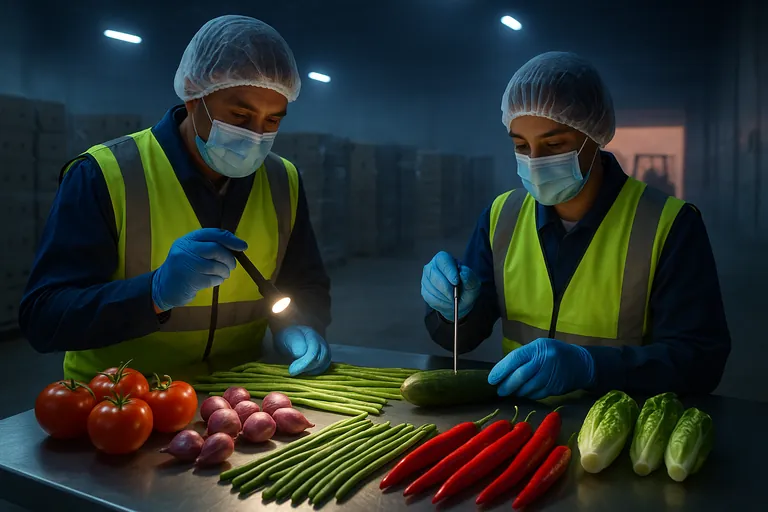
A practical, field-tested guide to getting EU-buyer–accepted pesticide residue COAs for Indonesian leafy vegetables in 2026. Exact test scope, sampling plan, LOQs vs MRLs, and the must-have fields to include.
If you export Indonesian vegetables into the EU in 2026, you don’t need theory. You need a COA that clears port checks and keeps retail programs happy. We’ve spent years shipping leafy greens and fruiting veg to exacting buyers, so here’s our proven playbook. Use it as your baseline process and adapt it to your crop, buyer and route.
The 3 pillars of an EU‑buyer–accepted pesticide COA
-
Representative sampling. The most sophisticated LC-MS/MS won’t save a bad sample. Your COA is only as good as your sampling plan.
-
Correct method and analyte scope. A broad QuEChERS multi-residue panel that actually aligns with EU MRLs for your commodity. Plus targeted add-ons where QuEChERS is weak.
-
Transparent, decision-ready reporting. A COA that shows LOQs, measurement uncertainty, EU MRL references, and a clear pass/fail decision rule. No guesswork for your buyer.
Week 1–2: Map your risk and lock the scope
Start by matching crop and farm practices to likely residues.
- Choose your lab. We recommend an ISO/IEC 17025 laboratory in Indonesia or Singapore that follows SANTE/11312/2021 (Rev. 1, 2023) method validation and QC. Ask for their accreditation scope. The lab must be accredited for pesticide residues by LC-MS/MS and GC-MS/MS, not just general chemistry.
- Define the analyte scope. For leafy greens export from Indonesia (pakcoy, kangkung, baby romaine), request:
- QuEChERS LC-MS/MS + GC-MS/MS multi-residue screen covering 350–500 pesticides typical for EU MRL vegetables.
- Dithiocarbamates by CS2 method reported as CS2. This group frequently triggers border issues on leafy veg.
- Chlorpyrifos, acephate, and methamidophos confirmed with LOQs at or below 0.01 mg/kg. Many buyers want 0.005 mg/kg for chlorpyrifos because the EU MRL is effectively at the limit of quantification (the “Chlorpyrifos LOQ EU” conversation comes up every season).
- If used in your IPM, add glyphosate/AMPA and chlorate/perchlorate as targeted tests. Not every buyer asks, but retail programs increasingly do.
- Align to EU MRLs. Check EU 396/2005 via the EU Pesticide Database for your specific commodity. MRLs shift, and reductions continue to roll out. Build a master list per crop and refresh quarterly.
Takeaway: A broad screen is good. A broad screen aligned to your crop’s MRLs is better. Add targeted methods where QuEChERS is weak.
Week 3–6: Nail the sampling plan and chain-of-custody
Here’s the thing. Most EU rejections we’ve seen weren’t because the lab was “wrong.” They were because the sample didn’t represent the lot.
-
Define the lot. Same farm block, same harvest date window, same spray history, same pack date. Don’t mix.
-
Sampling plan for fresh produce. For leafy greens, we use:
- ≤5 tons per lot: 1 composite sample.
- 5–15 tons: 2 composites.
-
15 tons: 3 composites.
- Each composite: 10–15 primary units taken across pallets and layers, then combined. Lab sample size: 1–2 kg after trimming obvious soil and outer damaged leaves.
-
Timing. Sample as close to harvest/pack as possible. Our rule: collect 24–48 hours pre-pack or at pack-out. If you test a week earlier, spray or irrigation changes can invalidate the result.
-
Keep a counter-sample. Split the composite into A/B. Send A to lab. Keep B sealed, chilled at 0–4°C for 7–10 days. If a question arises, you can retest.
-
Chain-of-custody must include: lot ID, farm and block, crop and scientific name, harvest and sampling dates, number of primary units, sampler’s name, seal numbers, temperature at handover, requested analyte scope, decision rule, and signatures. In my experience, missing chain-of-custody fields are a red flag for EU buyers.
Takeaway: Make the sample defensible. Composite correctly, document it, and keep a reserve.
Week 7–12: Methods, LOQs, and the COA format buyers expect
What should be on the COA so EU buyers say “yes”?
- Laboratory details: ISO/IEC 17025 accreditation number, lab address, and the accredited scope referencing pesticide residues.
- Sample identification: product name with scientific name, lot ID, farm/block, harvest and sampling dates, sample condition on receipt.
- Methods: QuEChERS extraction with LC-MS/MS and GC-MS/MS, plus any targeted methods used (e.g., dithiocarbamates CS2, glyphosate/AMPA).
- Analyte list with result, unit (mg/kg), LOQ per analyte, and corresponding EU MRL for the specific commodity.
- Measurement uncertainty (MU) and the decision rule. Most EU programs consider compliance if result + MU ≤ MRL. Spell this out.
- Statement of conformity: clear pass/fail based on EU 396/2005.
- Dates: sample receipt, analysis, and report issue date. Plus signatures of the authorized signatory.
We include all of the above in our COAs for Baby Romaine (Baby Romaine Lettuce) and Loloroso (Red Lettuce). Buyers stop asking follow-ups when everything they need is on one page.
Is an Indonesian ISO 17025 lab COA accepted in the EU, or will they retest?
Usually yes, buyers accept it, provided the lab is ISO/IEC 17025 accredited for the methods used and references SANTE/11312/2021 QC criteria. But official controls at EU borders can still sample and retest any shipment. High-risk products or routes face higher frequencies under the evolving official controls regime. We plan for occasional border retests even with clean COAs.
What LOQ is acceptable if the EU MRL is at the limit of quantification?
Your LOQ must be at or below the MRL. When the EU MRL equals 0.01 mg/kg, we’ve found most retailers prefer LOQs of 0.005 mg/kg for critical actives like chlorpyrifos, acephate, and methamidophos. It gives margin for MU and avoids “ND at 0.01” looking like a cliff edge.
How many samples per lot for leafy vegetables?
Use the lot-based approach above. One composite per ≤5 tons, then scale. For continuous retail programs, most EU buyers accept one COA per lot per commodity as long as the farm block and spray records are consistent. If your transit time is long or weather forces a spray, resample.
Which pesticide panel should I request for kangkung or pakcoy?
Ask your lab for a QuEChERS LC-MS/MS + GC-MS/MS multi-residue panel covering organophosphates (chlorpyrifos, profenofos, acephate, methamidophos), pyrethroids (cypermethrin, lambda-cyhalothrin), carbamates (carbaryl, carbendazim where relevant), neonicotinoids (imidacloprid, acetamiprid), spinosyns (spinosad, spinetoram), tetramic/tetronic acids (spirotetramat), and fungicides commonly used in tropical leafy greens. Add dithiocarbamates CS2. If your IPM uses glyphosate or glufosinate around beds, test for those explicitly.
How long before shipment should I test so the COA is still valid on arrival?
There’s no formal EU “validity period.” Commercially, for leafy veg we aim to sample and test within 2–5 days of packing. If your sea transit is long, keep your counter-sample and spray records ready. Retail programs often ask that the COA sampling date be within 7 days of pack date.
Why do EU border checks reject even when the COA shows ND?
- LOQ too high. ND at 0.02 mg/kg isn’t helpful if the MRL is 0.01. Fix: ensure LOQ ≤ MRL, ideally 50% of MRL for high-risk actives.
- Analyte not in scope. We’ve seen COAs that missed methamidophos while testing acephate. EU labs found the metabolite. Fix: include both parent and key metabolites.
- Dithiocarbamates reported high as CS2. Natural sulfur compounds and sanitizers can skew results. Fix: tighten pre-harvest practices and water sanitation, and set realistic LOQs with your lab.
- Non-representative sampling. Cherry-picked leaves don’t reflect the lot. Fix: stick to composite sampling across pallets and layers.
- MRL changes between sampling and arrival. Fix: monitor MRL updates and request the lab to reference the exact MRL database snapshot date on the COA.
- Poor chain-of-custody. If the identity of the lot is unclear, authorities may disregard the COA. Fix: lock your documentation.
Takeaway: Most “surprise” failures are preventable with a better scope, lower LOQs, and disciplined sampling.
Practical timeline we use for EU leafy greens
- Day 0: Harvest planning review. Confirm PHIs and recent sprays.
- Day 1: Composite sampling at farm or packhouse. Ship chilled to lab same day.
- Day 2–4: Analysis (express service). Keep counter-sample sealed.
- Day 4–5: COA issued. Internal QA review against EU MRLs and buyer specs.
- Day 5–6: Pack and ship with COA in docs pack and e-copy to buyer.
For our Baby Romaine (Baby Romaine Lettuce) and Loloroso (Red Lettuce), this rhythm gives enough buffer for a recheck without missing the vessel. For fruiting veg like Japanese Cucumber (Kyuri) or Red Cayenne Pepper (Fresh Red Cayenne Chili), we follow the same approach but tailor the analyte emphasis.
Resources and next steps
- EU Pesticide Database. Confirm commodity-specific MRLs before each season. Document the lookup date.
- SANTE/11312/2021 (Rev. 1, 2023). Share this with your lab. It’s the current EU reference for method validation and QC of pesticide residue analysis.
- COA checklist. If a field is missing, your buyer will ask for it. Build a one-page internal checklist and tie it to shipment release.
If you need a ready-to-use, EU-accepted COA template and a sampling SOP we actually use in our exports, Contact us on whatsapp. We’ll share the template and adapt the analyte scope to your crop and buyer spec. You can also explore our range of export-grade vegetables here: View our products.
Final note. Regulations evolve, and official controls are updated periodically. Treat this guide as a tested baseline. Then keep iterating with your lab, your farm team, and your buyer. That’s how you turn clean COAs into consistent EU programs.