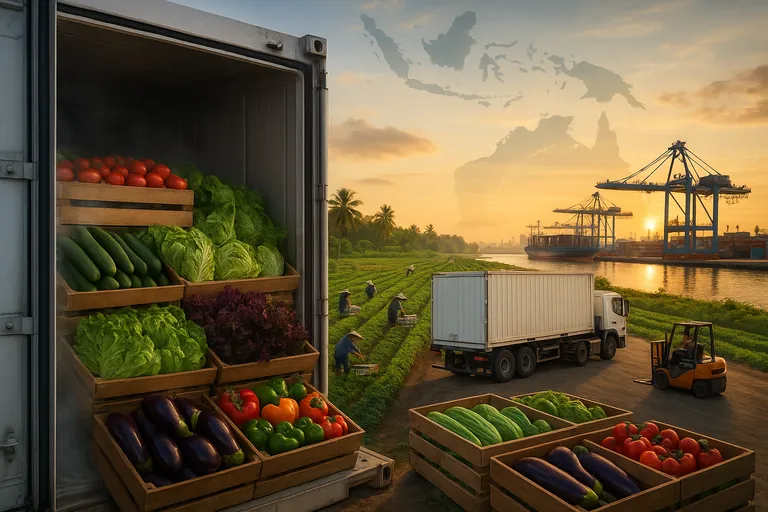
A step-by-step playbook to secure 0% duty for Indonesian fresh and frozen vegetables entering the Philippines in 2026 using ATIGA Form D, with clear FDA vs BPI rules, HS code examples, exact Box 8 wording, a document checklist, and how to fix Form D issues fast.
If you’ve ever watched a clean vegetable shipment get stuck at Manila because of one line on the Form D, you know how painful this can be. We’ve been there. We went from paying 5% duty to 0% in three consecutive trials by tightening just three things: HS codes, origin criterion in Box 8, and Philippine-side SPS timing. Here’s our 2026 playbook.
The 3 pillars of fast, 0% duty clearance under ATIGA
- Classify right, once. HS classification drives everything. Use AHTN 2022 at 8–10 digits on the Philippines side, but align the Form D at 6 digits. For common Indonesian vegetables we ship:
- Fresh: Tomatoes 0702, Cucumbers including Japanese Cucumber (Kyuri) 0707 00, Lettuce including romaine types like Baby Romaine 0705 19, Onions 0703, Carrots 0706 10, Beetroot like Beetroot (Fresh Export Grade) 0706 90, Radishes like Red Radish 0706 90, Eggplant like Purple Eggplant 0709 30, Peppers like Red Cayenne Pepper 0709 60.
- Frozen: Sweet corn like Premium Frozen Sweet Corn 0710 40, Okra like Premium Frozen Okra 0710 80, Bell peppers like Frozen Paprika (Bell Peppers) - Red, Yellow, Green & Mixed 0710 80, Mixed veg like Frozen Mixed Vegetables 0710 90, Edamame like Premium Frozen Edamame 0710 22. Check the Philippine Tariff Finder or AHTN for final 8–10 digit codes. Then confirm the ATIGA rate for 2026. Most 07xx lines are 0% under ATIGA, but verify per subheading.
-
Tell a clean origin story on ATIGA Form D. For vegetables planted, grown, and harvested in Indonesia, the ATIGA origin criterion is Wholly Obtained. In Box 8, we typically state: “WO”. That’s it. If any non-Indonesian vegetable is mixed in (common in frozen blends), use RVC40 or CTH as applicable, and keep your cost build-up on file. We maintain farm harvest records, packing run logs, and field-to-invoice traceability. Customs loves traceability.
-
Time Philippine SPS and customs steps together. Your importer needs a valid BPI SPS Import Clearance (SPSIC) and a phytosanitary certificate from Indonesia’s NPPO. Pair those with the e-Form D through the ASEAN Single Window. In our experience, when these three move in sync, E2M processing is smooth and inspections are routine.

Week 1–2: Pre-shipment plan that avoids 90% of problems
- Decide ATIGA vs RCEP. Both Indonesia and the Philippines implement RCEP. But for vegetables, ATIGA usually offers 0% and a simpler “WO” path. We default to ATIGA unless there’s an outlier HS with a better RCEP rule or rate.
- Lock your HS map. Build a master list per SKU. Example: Tomatoes 0702, Onion 0703, Carrots (Fresh Export Grade) 0706 10. Share the list with your broker to confirm the AHTN codes they’ll lodge.
- Origin criterion playbook. For fresh and frozen veg all grown in Indonesia, use WO. For any blend with imported components, prepare RVC40 worksheets or confirm tariff shift to CTH depending on the ATIGA PSR for that subheading.
- Paperwork calendar. Get the importer to apply for BPI SPSIC 2–3 weeks before ETD. SPSIC is typically valid for around 60 days from issuance and is shipment-specific. Don’t let it expire. Align your harvest, pack date, and sailing.
- Choose e-Form D. The Philippines accepts ATIGA e-Form D via the ASEAN Single Window. We see fewer holds when the e-Form D data lands ahead of arrival and mirrors the commercial documents.
Practical takeaway: Pre-clear your HS codes and Box 8 wording with your broker. If they sign off, your odds of a seamless E2M preferential claim jump dramatically.
Week 3–6: First shipment execution — where small mismatches get expensive
- Mirror descriptions across documents. The Form D description must match the invoice and packing list at line-item level. If your Form D says “Fresh Japanese cucumbers, 070700,” don’t call them “Kyuri” only on the invoice. Use both.
- Quantity units. Keep units consistent. If Form D shows 10,000 kg, don’t present 10 MT on the invoice and 9,990 kg on the packing list. Minor variances can be accepted, but avoid them.
- Phytosanitary + SPSIC pairing. Attach Indonesia’s phytosanitary certificate that clearly references the same consignor/consignee and products. Philippine BPI PQS checks this closely.
- Preferential claim in E2M. Your broker should flag ATIGA, cite the e-Form D reference, and ensure the country of origin is Indonesia. We often send a pre-alert package with PDF copies of invoice, PL, B/L, Form D printout, SPSIC, and phyto.
What’s interesting is how often we see rejections caused by HS mismatches alone. Three out of five issues our partners raise come back to a code mismatch between the Form D and the lodged SAD.
Week 7–12: Scale, optimize, and reduce inspections
- Standardize Box 8 language. We use templates like “WO” for single-origin shipments and “RVC40” only when we have the costed BOM signed off by QA and Compliance.
- Build a traceability pack. Farm lists, harvest dates, pack house batch IDs, and QC logs. Keep it ready. When an officer asks for proof of origin, speed matters.
- Maintain a tariff/rule tracker. Rates and Product Specific Rules can get updated. A 15-minute quarterly review avoids surprises.
- Expand SKUs only after 2–3 clean entries. Once your Baby Romaine, Purple Eggplant, or Loloroso (Red Lettuce) clear smoothly, then add frozen lines like Frozen Mixed Vegetables.
Do fresh vegetables need Philippine FDA or only BPI SPS Import Clearance?
Short answer: For fresh vegetables, your importer needs a BPI SPS Import Clearance and post-arrival BPI inspection. No FDA product registration or FDA import permit is required for fresh, unprocessed vegetables. FDA applies to processed food. Your importer still needs to be a registered/accredited importer with Philippine Customs and must comply with BPI regulations.
Takeaway: Think BPI for fresh produce. Think FDA for processed items. If you’re shipping blanched IQF vegetables, they’re still “vegetables” under HS 0710 and remain under BPI for SPS, not FDA product registration.
Which origin criterion belongs in Box 8 of ATIGA Form D?
For vegetables grown and harvested in Indonesia: “WO”. Sample Box 8 line:
- Description: Fresh cucumbers (Kyuri), 070700
- Origin criterion: WO
- Gross weight: 6,500 kg If you must use a transformation rule, we’ve used: “RVC40” or “CTH” depending on the ATIGA PSR. Match the exact PSR to your HS code.
How do I make sure customs applies 0% duty under ATIGA in 2026?
- Ensure the HS code on the Form D matches the importer’s AHTN code at 6 digits.
- Use e-Form D and pre-alert the broker. The Philippines accepts e-Form D. Hardcopy is typically not required when the e-document is validated.
- Keep the consignee name, invoice number/date, and quantities consistent across all documents.
- File the preferential claim at the time of import entry in E2M. If you must claim later, your broker can pursue a post-entry amendment/refund with a valid Form D, usually within a defined period after importation.
Can I claim RCEP instead of ATIGA for Indonesian vegetables to the Philippines?
Yes. But our practical view: pick the path of least friction. ATIGA for Indonesian vegetables is usually 0% and is widely understood by brokers and officers. RCEP can be useful where rules or rates are better. Just don’t mix regimes on the same line item and make sure your certificate type matches your claim.
What documents must accompany Form D at Philippine customs for fresh vegetables?
- ATIGA e-Form D (or paper Form D if e-Form D isn’t available) with correct HS code and Box 8
- Commercial Invoice and Packing List
- Bill of Lading/Air Waybill
- BPI SPS Import Clearance (valid at time of shipment and arrival)
- Phytosanitary Certificate from Indonesia NPPO
- Any port-required pre-alerts and broker authority documents
Tip: We include harvest and pack dates on the invoice for perishable shipments. It answers questions before they’re asked.
How long is a BPI SPS Import Clearance valid and when should I apply?
SPSICs for vegetables are typically valid around 60 days from issuance and are shipment-specific. Apply 2–3 weeks before your planned ETD. Don’t ship if the SPSIC will expire before arrival. If plans shift, reapply rather than gamble on an extension.
What if my ATIGA Form D has a typo or is issued late—can I still claim preference?
- Minor errors. Under ATIGA, minor discrepancies that don’t cast doubt on origin can be accepted. But don’t rely on officer discretion.
- Issued retroactively. ATIGA allows retrospective issuance in exceptional cases. The certificate must be marked “Issued Retroactively” in Box 13 and is generally valid for 12 months from issuance.
- Replacement certificates. If the original is lost, stolen, or destroyed, request a replacement marked “Replacement of Certificate No. …”.
- Post-entry claim. If you cleared without preference, you can often lodge a post-entry amendment/refund with a valid Form D within the statutory window. Your broker will guide you on timelines. Actionable fix: When a typo appears, we ask the issuing authority to reissue the Form D or annotate as permitted. Speed beats debate at the port.
The five mistakes that kill preferential claims (and how to avoid them)
- HS mismatches between Form D and the SAD. Solve with a shared HS master list and pre-clearance with the broker.
- Wrong Box 8 criterion. Use “WO” for Indonesian-grown vegetables. Use “RVC40” or “CTH” only with supporting worksheets.
- Late or missing SPSIC. Don’t ship without a valid BPI SPSIC aligned to the exact products and quantities.
- Transshipment without evidence of non-manipulation. If you route via a third country, maintain through B/L and storage-only proof.
- e-Form D data not matching invoice details. Mirror descriptions, quantities, and consignee details across all docs.
Resources and next steps
- Quick Box 8 wording you can copy for wholly obtained veg: “WO”. If you need RVC, use “RVC40”.
- Keep a one-page checklist per shipment: HS code at 6 digits, e-Form D reference, SPSIC number and validity date, phyto number, invoice/PL alignment, consignee name spelling.
- Use ATIGA unless your tariff check shows a real RCEP advantage. Simpler rules save time at the port.
Need help aligning HS codes or drafting Box 8 so E2M accepts 0% on the first try? In our experience, a 15-minute review before you apply for SPSIC prevents most roadblocks. If you’d like us to sanity-check your documents, feel free to Contact us on whatsapp or browse what we export and how we pack here: View our products.
Final note: Rates and procedures evolve. The guidance here reflects what we’re seeing on Indonesian vegetable shipments into the Philippines heading into 2026. Always confirm the latest ATIGA tariff line, PSR, and BPI SPSIC rules before you ship. We do, every single time.